Call the shop(469) 777-6701
☎ Call (469) 777-6701 Visit
Home/Automotive Repair

Automotive repair in Plano, TX.

The mechanical side of a collision is handled in the same building as the panel work. Suspension, steering, cooling, electrical, and alignment are diagnosed properly and repaired before the vehicle goes back to you. Extreme Hail & Collision has done automotive repair alongside panel work in Plano since 2022, with a 5.0 rating on Google.

One shop, one invoiceDiagnosed before quotedRoad tested before collectionLifetime workmanship warranty
Inside the Extreme Hail & Collision shop in Plano, TX Diagnosed first

What this page covers, and what it does not.

This is collision-related automotive repair, done at our Plano shop. The mechanical work that comes with an impact, a curb strike, or a storm is done in the same building as the panel and paint work rather than sent out to a mechanic while your vehicle sits. Panels and rust are auto body repair; refinishing is the auto paint shop; and storm dents are hail damage repair. This page is the part underneath.

We do not do routine servicing. No oil changes, no scheduled maintenance, no timing belts, no engine rebuilds. If your vehicle needs an inspection or a service interval, a general auto mechanic is the right call, and we will say so rather than taking the booking. Routine car repair is a different trade from collision work.

What we do is the vehicle repair that follows damage, which is a different job from routine servicing. It starts with knowing what the impact actually reached, and most of that is not visible from outside.

What an impact reaches that you cannot see.

Body damage is the part you notice. The hidden damage underneath is the part that costs you later, and post-collision work is the vehicle repair most shops leave to somebody else.

A front impact reaches the radiator, the condenser, the cooling fan, and the hoses before it reaches anything expensive, and in a Plano summer that matters more than it would elsewhere. A radiator that is bent but not leaking will still run hot, and running hot is how a repairable collision turns into an engine problem three weeks later.

Hitting a curb, a pothole, or road debris loads the suspension, and so does any wheel-first impact. Control arms, struts, tie rods, and wheel bearings all take that load, and a bent control arm does not look bent. It shows up as a vehicle that pulls, or as tires that wear on one edge over the following few thousand miles.

A side impact reaches the door wiring before it reaches anything else. Window motors, mirror adjusters, speakers, and lock actuators all run through the harness in the door, and a pinched wire fails intermittently rather than immediately, which is the hardest kind of fault to chase later.

Any impact can move an alignment out of specification, which is why we check it rather than assume.

Is it safe to drive after an impact?

This is the question people ask first and the one worth answering properly, because the wrong call here is expensive and occasionally dangerous.

Do not drive it if the steering pulls hard, if the steering wheel shakes or the car shakes at speed, if you hear grinding from a wheel, if a wheel sits at an odd angle, if fluid is leaking under it, if there is a burning smell, or if the ABS light, airbag light, or traction control light came on at impact.

Probably fine to drive in if it steers straight, stops normally, holds temperature, has all its lamps working, and nothing is dragging or rubbing. A minor accident or a fender bender at parking speed usually falls here.

Worth a phone call either way. Describe what it is doing, and we will tell you whether to drive it in or wait for the truck. That call costs nothing and is a great deal cheaper than turning a repairable suspension fault into a wheel bearing failure on the Tollway.

The one that catches people out is a fluid leak. A puddle under the front after a front impact is usually coolant rather than oil, and driving on it is how a cooling repair becomes an engine repair.

Symptoms that mean something moved.

People usually notice one of these before they notice the damage that caused it, and each points somewhere specific.

  • The vehicle pulls to one side on a flat road, or the steering wheel sits off center when you are going straight. That is an alignment check, and sometimes a bent component behind it.
  • Uneven tire wear along one edge. Toe out of specification scrubs rubber off in a few thousand miles, and the tire is the receipt.
  • The temperature gauge climbs in traffic. Overheating after a front impact points at the radiator, the cooling fan, or a coolant leak, and it is the symptom worth acting on fastest.
  • A dashboard warning or check engine light that appeared at the moment of impact, or a day or two after. A diagnostic scan reads what the vehicle recorded rather than what anyone guesses.
  • Something electrical works sometimes. A window, a lock, a mirror, or a lamp behaving intermittently usually means a pinched wire, a short circuit, a blown fuse, or a failed relay rather than the part itself.
  • A knock, clunk, grinding, or rattle over bumps, or a vibration through the floor at speed. That is suspension, and it is worth finding before it becomes a drivability problem.
  • Air conditioning that stopped being cold after a front impact. The condenser sits ahead of the radiator and takes the hit first.

If you recognize any of these after an impact, bring it in. Diagnosis is free and included in the estimate.

What we repair.

  • Suspension repair. Strut replacement, shock absorbers, coil springs, control arms, ball joints, bushings, sway bar links, and the mounting hardware around them.
  • Steering. Tie rods, the steering rack, the steering knuckle, power steering lines, and the column where an impact has reached it.
  • Four-wheel alignment. Camber, caster, and toe set to manufacturer specification, with thrust angle checked on the rear.
  • Cooling system repair. Radiator repair and radiator replacement, condensers, cooling fans, hoses, water pumps, thermostats, coolant leaks, and the mounts that hold all of it in place.
  • AC repair. Condensers, compressors, and lines damaged in a front impact are evacuated and recharged with the correct refrigerant rather than topped up.
  • Electrical repair. Wiring repair on harnesses and connectors, grounds, fuses, relays, batteries, alternators, lamp assemblies, window and lock motors, and the modules an impact has disturbed.
  • Drivetrain. CV axles, CV joints, and driveshafts on a wheel-first impact, plus engine mounts and transmission mounts.
  • Brake repair. Brake lines, hoses, ABS components, and hardware damaged by an impact, and the hydraulic side where a line has been compromised.
  • Wheel repair and tire replacement. Bent wheels, damaged rims and tires that took the impact rather than the bodywork.
  • Exhaust and fuel. Exhaust components and fuel lines disturbed by an underbody or undercarriage impact.

Parts, and who decides which ones.

On mechanical work, the parts question decides both the price and how long the repair lasts, and the carrier usually has an opinion.

OEM parts are made by or for the manufacturer. On suspension and steering, that matters more than it does on a panel, because geometry and load ratings are engineered around specific components.

Aftermarket parts range from good to poor. A quality aftermarket control arm is fine. A cheap one can sit slightly out of specification from new, which shows up as an alignment that will not hold.

Used and salvage parts have a place on older vehicles, particularly for items that do not wear, and a good used assembly from a breaker can be the sensible answer where a new one is on back order.

Carriers frequently specify aftermarket or used parts to control cost, and a shop on that carrier's program has agreed in advance to accept them. We have no such agreement. We tell you what the estimate calls for, what it means for how the repair holds up, and where we think the carrier is wrong.

Alignment is the one most people skip.

Alignment is the cheapest item on a Plano automotive repair estimate and the one that costs the most to ignore.

An impact does not have to be hard to move geometry. A curb at parking speed can shift a toe setting enough to scrub a set of front tires down inside a few thousand miles, and the driver never connects the two events.

The symptoms are easy to read once you know them. The vehicle pulls to one side on a flat road. The steering wheel sits off center when you are going straight. The tires wear on one edge rather than evenly. The steering feels vague or wanders at speed.

We check alignment after any repair that could have disturbed a mounting point, and we set camber, caster, and toe to manufacturer specification rather than to a green light on a screen. Where a bent component is the reason the numbers will not come in, we tell you that instead of adjusting around it.

Diagnosis before quoting.

Guessing is what makes a mechanical estimate wrong in both directions, so nothing gets quoted at the Plano shop until it has been looked at.

Every vehicle comes in for a proper assessment before a number goes on paper. That means a visual inspection of the impact area, a check of every system in the path of the damage, and a road test where the vehicle is safe to drive, because some faults only appear under load and a test drive is the only way to find them. That road test is the last step before we call you.

Warning lights and fault codes get read and interpreted rather than cleared. A code that returns after a reset is telling you something, and clearing it to make the dashboard look clean is how a fault leaves the shop with the vehicle.

The collision repair page covers the electronic scanning and calibration side in detail, since that work is booked as part of a collision repair rather than separately.

When your carrier's estimate misses the mechanical side.

Extreme Hail & Collision is not a direct repair program member. A DRP shop is on an insurer's list because it agreed to that carrier's pricing and cycle times. We never signed one.

On automotive repair, that gap shows up more than anywhere else. An adjuster writing from photographs in an office somewhere sees panels. They do not see a bent control arm, a hairline radiator crack, or a pinched harness, because none of that is visible in a photograph taken in a parking lot.

So the first estimate frequently covers the body work and stops. We document what the mechanical assessment actually found, photograph it, and file a supplement. That is a normal part of the process rather than a sign something went wrong, and you hear about a change in scope from us before it happens.

One shop instead of three.

The usual arrangement in Plano is that a body shop fixes the panels and sends the mechanical work to somebody else. That means two bookings, two waits, two invoices, and a gap where each shop assumes the other checked something.

We do the auto body repair, the paint, the mechanical repair, and the alignment in this building on Ohio Drive. Where a dent has not broken the paint, paintless dent repair handles it without the panel ever coming off. Auto glass and sensor calibration are the only two things we send out, both to a specialist, and we book and coordinate them.

It matters most on the things that fall between trades. An alignment that will not come in because a body mounting point moved. A cooling fault that only shows up once the front end is back together. Nobody is passing that between two businesses.

If somebody else did the repair and it still drives wrong.

This is a common call, and there is nothing awkward about making it.

A vehicle that came back from a body shop looking correct but driving wrong usually has one of three things left in it. An alignment that was never checked, because it was not on the estimate. A bent component that was adjusted around rather than replaced, so the numbers came in on the rack and went out again on the road. Or a fault that was cleared instead of diagnosed, which comes back on its own schedule.

We will look at it and tell you what we find, including when the answer is that the original repair was fine and the problem is unrelated wear. That happens, and saying so is worth more than finding something.

Where the work is still inside somebody else's warranty, we will say that too, because taking it back to them costs you nothing and taking it to us does not.

Bring the original estimate if you have it. It tells us what was supposed to happen, which is the fastest route to working out what did not.

Written to pre-loss condition.

Pre-loss condition means the vehicle comes back the way it was before the damage, and on the mechanical side, that means how it drives rather than how it looks.

It steers straight. It tracks straight. It holds temperature. The systems that worked before the impact work after it. When a carrier's estimate falls short of that standard, we document the gap and take it back to them.

What automotive repair costs.

Vehicle repair after an impact has a wider range than panel work, because the same impact can reach one component or six.

JobTypical range
Four-wheel alignment$100 – $180
Estimate and diagnosticFree

Ranges reviewed September 2026. Not a quote.

Parts availability moves the timeline more than the labor rate does, and we tell you when a part is holding up the job rather than letting the promised date slip. On smaller jobs, it is worth checking the number against your deductible before filing, because paying out of pocket is often cheaper once you account for the claim.

A free estimate includes a free diagnostic rather than charging for it separately, because we would rather know what is wrong before we quote it.

How long it takes.

At the Plano shop, an alignment is an hour. A single suspension or cooling component is usually the same day or the next. Electrical fault tracing takes as long as the fault takes to find, which is the one item nobody can promise on. Multi-system vehicle repair runs alongside the panel work rather than after it, which is the whole point of doing both here.

Our workmanship carries a lifetime warranty for as long as you own the vehicle, and that covers the mechanical repair the same way it covers the panel work.

Across North Texas.

People usually arrive here second, and that is worth explaining rather than hiding.

Mechanical damage shows up on a delay. The body work gets done somewhere, the vehicle looks right, and then three weeks later it pulls, or a tire wears, or the temperature gauge creeps up in traffic. By then the body shop has closed the file, and the general mechanic does not want to open somebody else's collision claim. That gap is most of what walks through this door.

Plano is home ground, from the 75093 side across to the older streets east of 75, and most of our mechanical work starts here. Richardson and Carrollton come across the George Bush after a repair somewhere else did not settle. Frisco and Allen usually arrive first rather than second, wheel-first out of a parking structure with the alignment gone. McKinney and the northern county send the heavier work where the mechanical side runs alongside a full rebuild.

Further out, we take work from Dallas, Garland, Wylie, Prosper, Celina, and The Colony, and distance matters less on this service than on any other, because a second opinion is worth a drive when the first one did not hold.

Our shop is at 1101 Ohio Dr #111 in West Plano, 75093, just off the George Bush Turnpike and Preston Road, with parking at the door.

If the vehicle should not be driven, do not drive it. A steering or suspension fault is the one category where drivability matters most, and driving it in is the wrong call. Free pickup covers the whole area, and if it needs a tow, we will take delivery directly rather than have it sit in a storage yard.
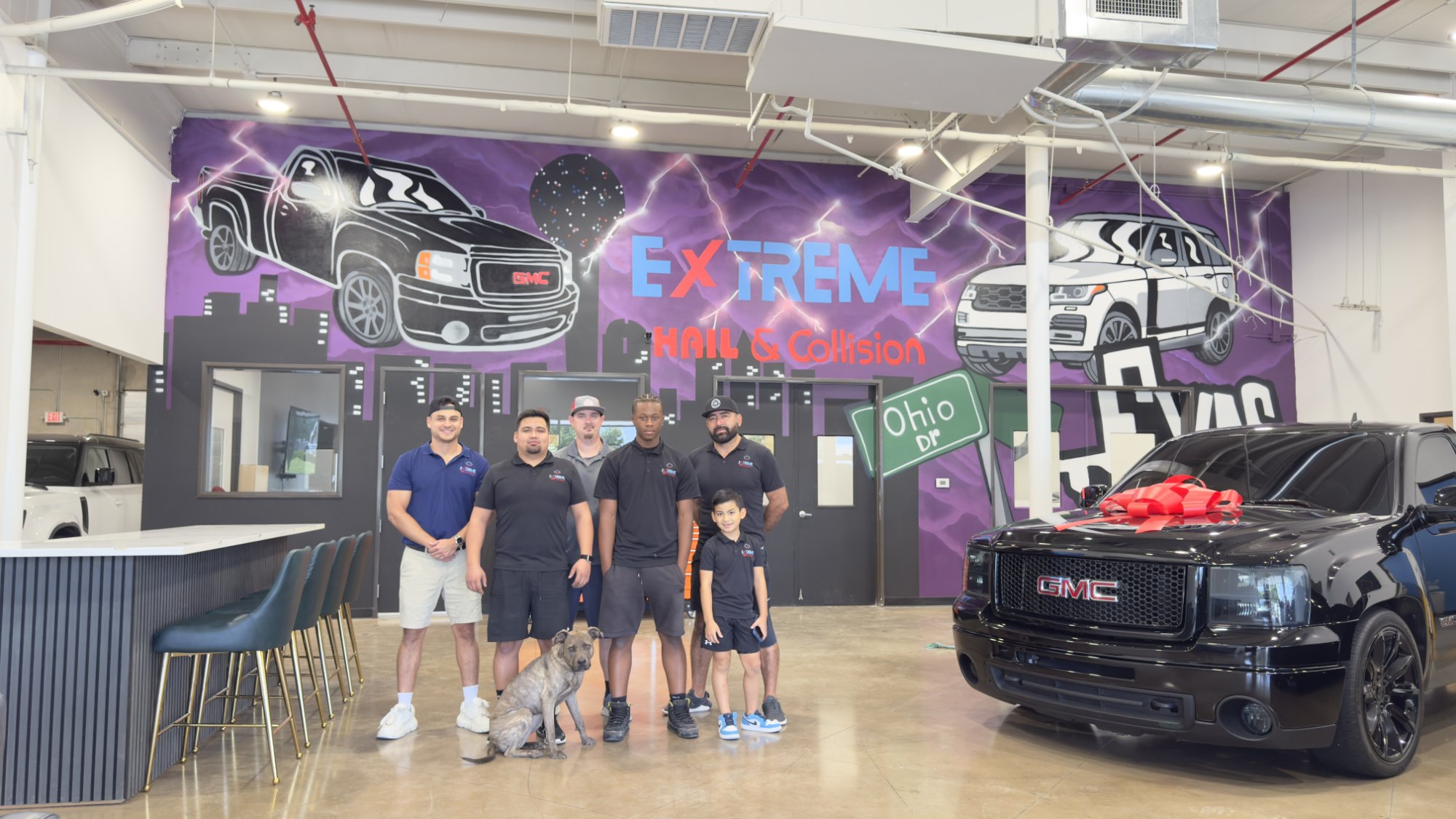
We work on domestic, import, Asian, and European vehicles, cars, SUVs, trucks, and vans, including fleet and commercial work and hybrid and electric vehicles. Extreme Hail & Collision has handled automotive repair in Plano, TX since 2022 and holds a 5.0 rating on Google. Family-owned, veteran-owned, Latino-owned, and not a direct repair partner for any insurance company. Read the reviews.

Automotive repair questions.

Do you do oil changes and routine servicing?

No. Extreme Hail & Collision in Plano handles collision-related automotive repair, which is the mechanical work that follows an impact. For scheduled maintenance, inspections, or engine work, a general auto repair shop or auto mechanic is the right call, and we will tell you so rather than taking the booking.

Is my car safe to drive after a minor accident?

Probably, if it steers straight, stops normally, holds temperature, and nothing is dragging. Do not drive it if the steering pulls hard, the car shakes at speed, a wheel sits at an odd angle, fluid is leaking, or a warning light came on at impact. Call and describe it, and we will tell you.

What mechanical damage happens in a collision?

At our Plano shop, most commonly, cooling components are damaged in a front impact, suspension and steering on a wheel-first or curb strike, and door wiring on a side impact. Alignment moves in almost any impact. None of it is visible from outside, which is why we assess before quoting.

Why does my car pull to one side after an accident?

Usually because the alignment moved, and sometimes because a suspension component bent. We check camber, caster, and toe against manufacturer specifications and identify whether a bent component is the reason the numbers will not come in.

Does my insurance cover mechanical damage from a collision?

It should, but the first estimate often misses it, because an adjuster writing from photographs cannot see a bent control arm or a cracked radiator. We document what the assessment found and file a supplement. The same applies to parts: where a carrier specifies aftermarket suspension components that will not hold an alignment, Extreme Hail & Collision puts the case in writing.

How much does an alignment cost in Plano?

Roughly $100 to $180 on its own. It is the cheapest item on a mechanical estimate and the most expensive one to skip, because a toe setting out of specification can ruin a set of front tires inside a few thousand miles.

Can you repair my radiator after a front impact?

Yes. Radiators, condensers, cooling fans, and hoses are standard vehicle repair work at the Plano shop. A bent radiator that is not leaking will still run hot, and running hot is how a repairable collision becomes an engine problem.

Why is my check engine light on after an accident?

Because the vehicle recorded a fault at the moment of impact or shortly after. A diagnostic scan reads what it recorded rather than guessing, and Extreme Hail & Collision interprets the code instead of clearing it to make the dashboard look clean.

My air conditioning stopped working after a front impact. Can you fix it?

Usually yes. The condenser sits ahead of the radiator and takes the hit first, and the compressor or the lines can go with it. We evacuate and recharge with the correct refrigerant rather than topping it up over a leak.

Another shop repaired my car, and it still drives wrong. Can you look at it?

Yes, and it is a common call. Usually it is an alignment that was never checked, a bent component adjusted around rather than replaced, or a fault cleared instead of diagnosed. Bring the original estimate if you have it. If the work is still inside somebody else's warranty, Extreme Hail & Collision will tell you that rather than quoting against it.

Do I need a separate mechanic after body work?

Not here. Extreme Hail & Collision does the panel work, paint, mechanical repair, and alignment in the same building, so there is one booking, one timeline, and one invoice rather than a handoff between two businesses.

Where to next.

Stop by the shop

Pull in. We'll take it from here.

Bring it in to the Plano shop, and we will tell you what the impact actually reached. Estimates are free and include the diagnosis. Walk in Monday to Friday, 9 to 6, or Saturday 10 to 1. We are at 1101 Ohio Dr #111 in West Plano, 75093, just off the George Bush Turnpike and Preston Road.

Call
(469) 777-6701
contact@extremehailcollision.com
Visit
1101 Ohio Dr #111
Plano, TX 75093
Just off the George Bush Turnpike & Preston Road
Hours
Monday to Friday9a to 6pSaturday10a to 1pSundayClosed
Get a Free Estimate Call (469) 777-6701